
When Photos Are Treated as Proof


A set of photos arrives with a completed job. The area looks clean, the site looks tidy, and nothing stands out as wrong.
From the office’s point of view, it feels like enough to close the task and move on.
It’s only when a client asks about a specific area, or a facilities manager queries whether a particular task was carried out, that the photos are looked at again more closely.
They show what was done, but not necessarily what was checked, what was covered, or what might have been missed. That moment is familiar in facilities, cleaning, and grounds services.
It’s common practice to rely on photos as confirmation that work has been carried out. A team attends site, completes the scheduled tasks, takes a set of photographs, and uploads them as part of the job record. From the office’s perspective, the evidence is there and the job can be closed. Most of the time, that process works without issue.
The difficulty isn’t that photos are misleading or untrustworthy. It’s that they’re often treated as complete evidence when they only show a small part of what happened on site. A photograph captures a moment, from a particular angle, after a particular task. It doesn’t show what happened before, what happened elsewhere, or how the rest of the service visit unfolded. In day-to-day operations, that limitation is easy to overlook.
A cleaning supervisor may receive images of a tidy area and assume the full schedule was completed, without knowing whether certain rooms were skipped or rushed due to time pressure.
A grounds maintenance team may upload photos of a maintained section of a site, while other areas remain untouched that day.
A facilities engineer may submit images confirming attendance, but those images don’t explain what was actually checked or how long was spent on site.
The photos look right, so the assumption follows.
Over time, photos begin to stand in for understanding rather than prompting it. Office teams feel reassured because something tangible has been received, and clients are satisfied because evidence has been shared. The limitation only becomes apparent when a question is asked that the photos can’t answer.
A photos operational situation
Consider a routine service visit carried out as part of a regular contract. The work is scheduled, the team attends, and a set of photos is uploaded at the end of the visit. The images show clean spaces and maintained areas, and from the office’s point of view the job looks complete.
When a client later queries whether a particular area was covered, or a facilities manager asks whether a specific task was carried out during that visit, the photos don’t clearly show the area in question or explain what the images are meant to demonstrate. The evidence exists, but it doesn’t resolve the uncertainty.
At that point, the office has limited options. Someone has to go back to the team for clarification, check schedules and notes, or arrange a return visit simply to confirm what should already be known. The issue isn’t that the work wasn’t done, but that the evidence doesn’t carry enough context to answer reasonable questions.
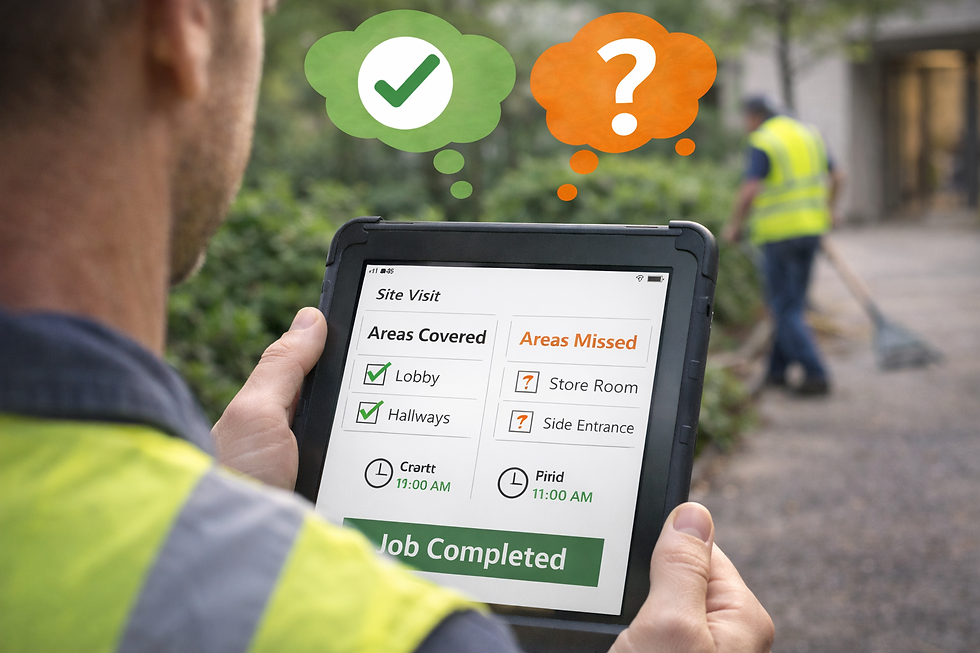
Organisations that experience less friction in these situations tend to treat photos differently. Images are captured alongside simple context that explains what task was being completed, which area was covered, and what the photo is intended to show. The photograph supports the record rather than acting as the record itself, so when questions arise later, the information needed to answer them is already there.
Some facilities teams achieve this by changing how evidence is captured rather than collecting more of it. Photos are taken alongside brief notes about the task, the area covered, and the timing of the visit, which reduces the need for interpretation after the fact. Tools such as WorkMobile are commonly used in this context to capture photos, time, and simple task context together as the work is carried out.
In operational services, having photos on file isn’t enough. What matters is understanding what those photos represent and what they don’t. Without that clarity, proof of work becomes proof of assumption.
About WorkMobileForms
WorkMobileForms is used by facilities, cleaning, and grounds teams to capture work details, photos, time, and checks as services are delivered. Information is available to office teams straight away, reducing the need for follow-up questions and unnecessary re-visits.
Further Reading


Comments