
When Nothing Was Missed Is an Assumption

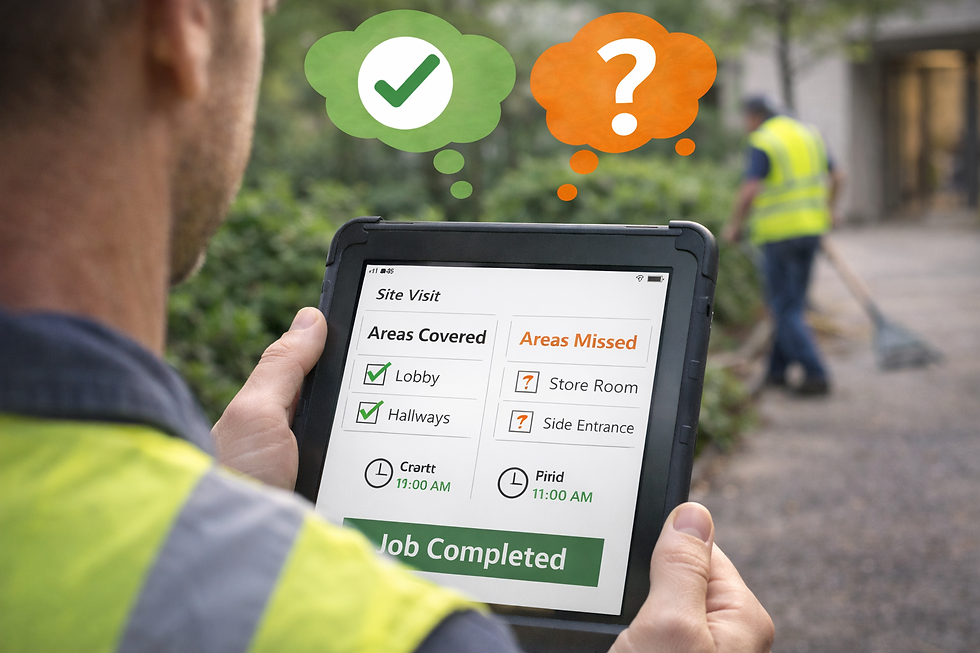
If you see something every day and it looks fine, you stop paying much attention to it. Over time, familiarity replaces scrutiny and the absence of problems starts to feel reassuring.
In facilities, cleaning, and grounds services, the lack of reported issues is often taken as a sign that everything is under control. Visits take place as scheduled, no problems are raised, and work continues without interruption. Gradually, that lack of noise becomes its own form of confirmation that coverage is complete.
Most of the time, that assumption feels reasonable. Routine services are delivered across familiar sites, teams know their areas, and work follows a predictable pattern. When nothing stands out, there is little incentive to look more closely at what happened during each visit.
The difficulty is that silence does not always mean completeness. Routine services involve large areas, repeated tasks, and changing conditions. Some locations are easier to access than others, some tasks are more visible, and some areas naturally receive more attention.
When time is tight or conditions are less favourable, small decisions are made to prioritise certain zones or defer less visible tasks. None of this is unusual, and none of it necessarily indicates poor performance. What often goes unrecorded is what was not covered.
As operations expand across multiple sites and routines settle in, these small gaps can persist without triggering any immediate signal. Because no issue is reported, the assumption that everything was covered remains unchallenged and, over time, hardens into expectation.
A familiar operational situation
A site is serviced regularly under an agreed contract. Each visit is completed on schedule and no issues are raised. From an operational perspective, the service appears stable and predictable.
Eventually, a client queries why a particular area appears neglected, or a site manager asks whether a section has been attended to recently. When records are reviewed, there is no clear indication that anything was missed. The visits took place, time was logged, and nothing was flagged as incomplete. What the records don’t show is which areas were actually covered during each visit and which were deferred.
At that point, understanding what happened requires reconstruction. Someone has to ask the team directly, rely on memory, or visit the site to confirm the situation for themselves. The issue isn’t that work wasn’t done, but that coverage was implied rather than recorded.
Teams that experience fewer surprises tend to approach this differently. Instead of relying on the absence of problems as confirmation, they make coverage explicit as part of routine work. Recording which areas were attended to and which were not, even when nothing went wrong, provides a clearer picture of how services are actually delivered over time.
Solutions such as WorkMobile are often used in this context to capture coverage information alongside routine tasks, allowing office teams to see what was completed, what was deferred, and what remains outstanding without relying on assumptions. This makes it easier to spot patterns early and address gaps before they turn into complaints.
In operational services, the absence of issues is not the same as knowing what was covered. Clear records of routine work make it possible to see what actually happened, even when everything appears to be running smoothly.
About WorkMobileForms
WorkMobileForms is used by facilities, cleaning, and grounds teams to capture attendance, coverage, tasks, and simple context as services are delivered. Information is available to office teams straight away, reducing reliance on assumptions and follow-up checks.
Further Reading


Comments